
Scoliosis
Scoliosis is a condition in which the spine curves to the side and rotates slightly; the vertebrae deviate from their natural alignment and form an S or C-shaped curvature.
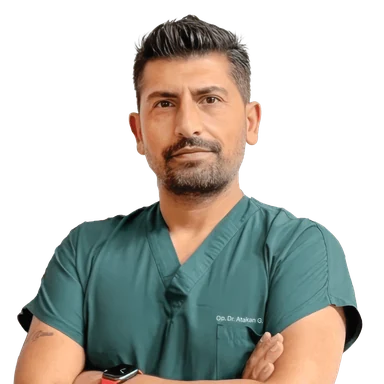
Dr. Atakan Güvendiren
Orthopaedics and Traumatology · Istanbul
{ AI · initial information }
onlineLet's Talk About Your Spine
AI answers do not replace a medical diagnosis.
Scoliosis is a condition in which the spine curves to the side and rotates slightly. Normally the spine should be a straight line, but in scoliosis an S or C-shaped curvature is seen.
Is the curvature in your spine making daily life difficult?
What is Scoliosis? Clear Definition of Spine Curvature
Scoliosis is a condition in which the spine curves to the side and rotates slightly. Normally the spine runs straight from the neck to the lower back with gentle natural curves; however, in scoliosis the vertebrae deviate from this natural alignment and form an S or C-shaped curvature.
Key characteristics of scoliosis
Lateral spine curvature: Deviation of the vertebrae from the normal vertical line. Rotation (twisting): The curvature is not just lateral bending; the vertebral bones may rotate slightly. Usually idiopathic onset: The cause of the most common type, 'idiopathic scoliosis', is not fully understood.
The right approach to spine curvature
Scoliosis, due to structural curvature and postural imbalances developing in the spine, can lead to pain, fatigue and restricted movement. With appropriate treatment approaches, this condition can be managed effectively. Surgical treatment options, applied when conservative methods prove unsuccessful and curvature progresses, are effective methods aimed at restoring spinal balance, reducing pain and improving movement comfort.
"With proper treatment, scoliosis allows for more balanced and comfortable movement."
Safe and controlled approach to scoliosis
Scoliosis is a structural spine problem characterised by lateral curvature and rotation, and over time can lead to postural distortion, pain, asymmetry and restricted movement. This condition can significantly affect daily life activities and quality of life. Regular monitoring, scoliosis-specific exercise programmes and bracing are preferred at the first stage. When these methods do not provide sufficient benefit or curvature progresses, surgical treatment options are applied as effective approaches aimed at restoring spinal balance, correcting curvature and regaining functional posture. Dr. Atakan Güvendiren
Who gets scoliosis?
Scoliosis can occur at any age, but is most commonly seen in childhood and adolescence.
It has a higher incidence in girls compared to boys.
Effects of scoliosis
Mild curves are usually asymptomatic.
In moderate to severe curvatures:
- Postural distortion
- Back and lower back pain
- Rare effects on breathing or cardiovascular function
The spine provides the connection between the central nervous system and other parts of the body. Disorders not only create pain and restricted movement, but also seriously affect quality of life and daily activities.
- Long-term pain and restricted movement
- Numbness or weakness due to nerve compression
- Postural distortions and deformity
How does spine curvature develop? Causes of scoliosis
Scoliosis is characterised by lateral curvature of the spine and sometimes rotation. This curvature can result from various factors and may present differently in each patient.
Idiopathic Scoliosis (Scoliosis of Unknown Cause)
- It is the most common type of scoliosis and usually begins during adolescence.
- Genetic factors may play a role; the likelihood of developing scoliosis increases in individuals with a family history of scoliosis.
- Usually does not cause pain, but there is a risk of progression.
Neuromuscular Scoliosis
- Results from muscle or nerve disorders.
- Occurs in conditions such as cerebral palsy, spina bifida or muscular dystrophy.
- Curvature develops due to imbalance of the muscles that support the spine.
Congenital Scoliosis
- Develops as a result of improper development of vertebral bones from birth.
- Usually detected at an early age and has a high risk of progression.
- May require surgery or close monitoring.
Other Causes
- Trauma or spinal injuries
- Infection or tumours
- Osteoporosis or degenerative changes (particularly in older individuals)
What Are the Signs of Scoliosis? Signs of Postural Changes and Asymmetry
Scoliosis is usually a slowly progressive condition that initially presents without symptoms. However, early detection is very important for preventing progression and establishing an appropriate treatment plan.
1. Visible Postural Abnormalities
- Shoulder Asymmetry: One shoulder may appear higher than the other.
- Waistline Irregularity: Uneven waistline may develop due to spinal curvature.
- Hip Asymmetry: The hips may appear at different heights or in a non-symmetrical manner.
- Scapular Prominence: The shoulder blades may not be equally aligned with each other.
2. Physical Symptoms
- Back or Lower Back Pain: May be seen particularly in advanced scoliosis.
- Muscle Tension and Fatigue: Certain muscles become overloaded due to asymmetrical posture.
- Curvature and Rotation: With slight rotation of the vertebrae, the trunk may shift to one side.
3. Early Detection Methods
- Mirror Check: When standing upright, observe whether the shoulders and waistline are symmetrical.
- Forward Bend Test (Adam's Test): When bending forward, asymmetry of the back and waistline becomes more apparent.
- Monitoring of Children and Adolescents: Regular postural checks are particularly important during periods of rapid growth.
Scoliosis Treatment: Planning According to Degree of Curvature
Scoliosis treatment is planned according to the degree of spinal curvature, the patient's age and growth potential. The aim is to stop progression of the curvature, reduce pain and maintain quality of life.
Mild Scoliosis (10°–20°)
- These are curvatures that are usually asymptomatic or cause minimal pain.
- Treatment Approach: Regular follow-up and medical check-ups
- Postural awareness and daily ergonomics
- Mild exercise and stretching programmes
Moderate Scoliosis (20°–40°)
- The curvature is more pronounced and some patients may show postural changes and mild pain.
- Treatment Approach: Physiotherapy and muscle-strengthening exercises
- If necessary, bracing, particularly in growing children and adolescents
- Regular X-ray checks to monitor progression of the curvature
Severe Scoliosis (40° and Above)
- The curvature is marked and the risk of progression is high.
- In some cases, breathing difficulties and movement limitations may occur.
- Treatment Approach: Surgical intervention: procedures to straighten and stabilise the spine
- Post-operative physiotherapy and rehabilitation
- Long-term follow-up to manage the recovery process
Special Cases
- In neuromuscular or congenital scoliosis, treatment is generally started earlier and surgery may be indicated more often.
- The patient's age, muscle strength and growth potential affect the treatment plan.
What Are Posture and Lifestyle Measures in Scoliosis?
Correct postural habits and lifestyle measures are of great importance in preventing progression of scoliosis and maintaining spinal health. Early intervention and regular follow-up slow the progression of curvature and improve quality of life.
Correct Postural Habits
- When Sitting: Sit with your back straight, shoulders relaxed and feet firmly planted on the ground.
- When Standing: Shoulders and hips should be symmetrical, with weight distributed equally.
- When Carrying Loads: Do not carry heavy loads on one side only; balance the stress on the back and lower back muscles.
Exercise and Muscle Strengthening
- Core and Back Muscles: Exercises that strengthen the abdominal and lower back muscles increase spinal stability.
- Stretching and Mobility: Increases spinal range of motion and reduces muscle tension.
- Low-Impact Cardio: Swimming, walking and cycling are suitable for individuals with scoliosis.
Daily Life and Ergonomics
- Work Area Layout: Desk and chair height should be adjusted to eye and shoulder level.
- Posture Breaks: When sitting for long periods, take breaks and do gentle stretching movements.
- Correct Footwear Choice: Shoes with proper arch support and minimal heel height should be preferred.
Nutrition and Weight Control
- Bone Health: Consume foods rich in calcium and vitamin D.
- Ideal Weight: Excess weight places extra strain on the spine and can accelerate progression of the curvature.
Regular Follow-Up and Check-Ups
- Regular orthopaedic check-ups are important for individuals with scoliosis.
- During adolescence and periods of rapid growth, X-ray imaging and postural evaluation should be performed.
- Changes detected early increase the effectiveness of the treatment plan.
Frequently Asked Questions
What is scoliosis and how does spinal curvature develop?
Scoliosis is a condition in which the spine curves to the side and rotates slightly. Normally the spine should be a straight line, but in scoliosis an S or C-shaped curvature is seen.
At what ages is scoliosis more commonly seen?
It most commonly occurs during childhood and adolescence. Rapid growth in adolescence increases the risk of progression of curvature.
Does scoliosis occur only in children, or can it also be seen in adults?
No, scoliosis can occur at any age. In children it is usually idiopathic; in adults it may result from degenerative causes.
Is scoliosis genetic? Does the risk increase if it is present in the family?
Yes, especially in idiopathic scoliosis, a family history increases risk. However, genetic factors alone do not always cause scoliosis.
Do girls carry a higher risk of scoliosis than boys?
Yes, progressive scoliosis is seen more frequently in girls, especially during adolescence.
What are the first signs of scoliosis?
Asymmetry in shoulders or hips, irregularity in the waistline, and sometimes mild back pain.
What should I do if I notice asymmetry in my shoulders or hips?
It is important to consult an orthopaedic specialist when detected early. Early diagnosis halts progression.
Does scoliosis cause pain?
Mild curvatures usually do not cause pain; in moderate and severe cases, back or lower back pain may develop.
How is scoliosis diagnosed? Which imaging methods are used?
After physical examination, X-ray and, if necessary, MRI are used to determine spinal curvature.
What is Cobb angle and how does it determine the degree of scoliosis?
Cobb angle is a method that measures the degree of curvature between vertebrae. It determines whether the curvature is mild, moderate, or severe.
Is treatment necessary for mild scoliosis?
Generally, regular monitoring, posture control, and exercise are sufficient.
Which treatment options are applied for moderate and severe scoliosis?
Physiotherapy, bracing, or surgical intervention in advanced cases may be required.
When is a scoliosis brace used and what is its effect?
It is used in moderate curvatures and in growing children to prevent the curvature from progressing.
When is surgical intervention recommended?
It is recommended when curvature is above 40–50° and the risk of progression is high, or if there is pain and loss of function.
Can physiotherapy and exercise correct scoliosis?
Although exercise cannot correct mild curvatures, it slows their progression and strengthens muscles.
Which exercises can be performed to slow the progression of scoliosis?
Core and back muscle strengthening exercises, stretching, and posture exercises are recommended.
How do posture and ergonomics affect scoliosis?
Prolonged incorrect sitting, bending, and carrying heavy loads increase the load on the spine and may accelerate curvature progression.
What precautions should be taken in daily life?
Correct posture, balanced weight distribution, regular breaks, and an ergonomic workspace are important.
How can nutrition and weight control affect scoliosis?
Nutrition that supports bone health and maintaining ideal weight reduces the load on the spine.
Does prolonged sitting or carrying heavy loads accelerate scoliosis?
Yes, uncontrolled posture and poor carrying habits can increase curvature.
Why does the risk of scoliosis increase during adolescence?
During rapid growth, vertebrae can shift more easily and curvature can progress rapidly.
What is the risk of scoliosis in children who play sports?
Playing sport does not prevent scoliosis, but appropriate exercise and muscle strengthening can slow curvature progression.
Does pregnancy affect scoliosis?
During pregnancy, weight gain and postural changes may temporarily affect curvature, but a permanent increase is not always observed.
Are special precautions necessary in neuromuscular or congenital scoliosis?
Yes, since the risk of progression is high, regular orthopaedic monitoring and surgical planning in some cases is necessary.
When should a doctor be consulted to prevent scoliosis progression?
Consult an orthopaedic specialist immediately if you notice asymmetry in shoulders or hips, develop back pain, or observe postural changes.
Schedule an Appointment
Your information will be sent to Dr. Atakan Güvendiren's clinic. A response will be provided within 24 hours.