
Elbow replacement
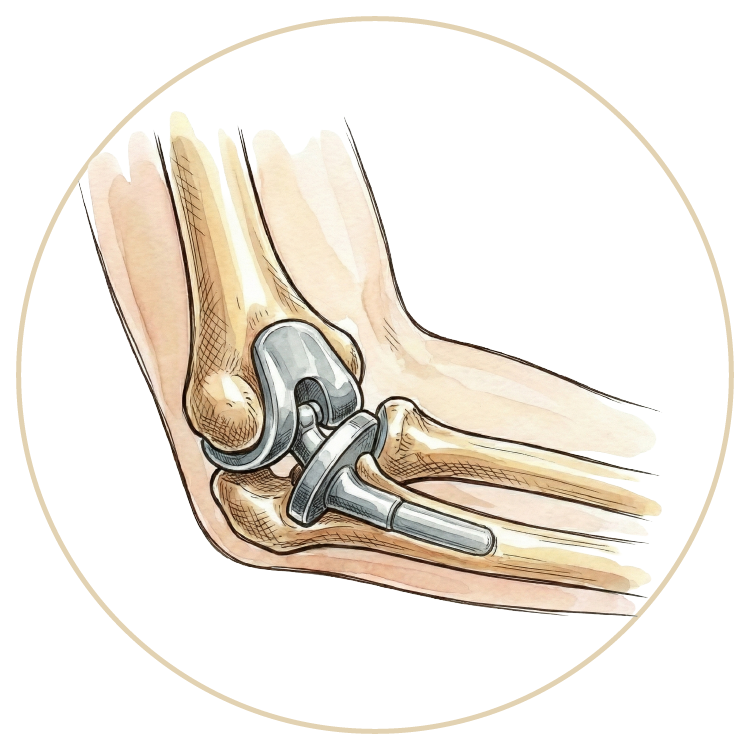
Elbow replacement (total elbow replacement) is a surgical treatment method used in cases of advanced cartilage loss in the elbow joint, joint surface deterioration, and permanent pain-causing damage. In this operation, the damaged joint surfaces are removed and replaced with an artificial joint made of metal and special polyethylene components.
Dr. Atakan Güvendiren
Orthopaedics and Traumatology · Istanbul
{ AI · initial information }
onlineLet's discuss prosthesis surgery
AI answers do not replace a medical diagnosis.
Elbow replacement (total elbow replacement) is a surgical treatment method used in cases of advanced cartilage loss in the elbow joint, joint surface deterioration, and permanent pain-causing damage.
Is Elbow Pain Making Your Daily Movements Difficult?
Elbow replacement (total elbow replacement) is a surgical treatment method used in cases of advanced cartilage loss in the elbow joint, joint surface deterioration, and permanent pain-causing damage. In this operation, the damaged joint surfaces are removed and replaced with an artificial joint made of metal and special polyethylene components. The aim is to reduce pain, increase range of motion, and enable patients to continue their daily living activities more comfortably.
The elbow joint is responsible for bending and straightening the arm and rotating the forearm. Rheumatoid arthritis, advanced osteoarthritis, joint deterioration following fracture, trauma and failed outcomes of previous operations can cause severe, irreversible damage to the elbow joint. When conservative treatments (medication, physiotherapy, injections, bracing) provide insufficient benefit, elbow replacement becomes an effective option.
Comfortable Movement with Elbow Replacement
Advanced damage developing in the elbow joint can be managed with appropriate treatment approaches. In cases where conservative methods provide no benefit, elbow replacement is an effective surgical treatment option aimed at reducing pain and improving functional ability.
"In elbow joint problems, comfortable movement can be regained with appropriate treatment."
Elbow Pain Can Be Controlled with Treatment
Elbow replacement is a surgical treatment method used in patients with advanced cartilage loss and joint damage in the elbow joint. This condition can lead to pain, limited movement, and reduced quality of life. Drug treatments, physiotherapy applications, and injections are preferred at the first stage. When these methods do not provide sufficient benefit, elbow replacement surgery is applied as an effective treatment option aimed at reducing pain and improving joint functions. Dr. Atakan Güvendiren
Elbow Replacement Surgery: Indications and Who Is It Suitable For?
Elbow replacement surgery is a surgical treatment method preferred in patients who have developed advanced damage to the elbow joint and have not benefited sufficiently from conservative treatments. The aim is to reduce pain, increase joint movement, and make daily living activities more comfortable.
Principal Indications
-
Advanced rheumatoid arthritis
-
Severe osteoarthritis
-
Joint deterioration developing after trauma and fractures
-
Severe deformity and cartilage loss on the joint surface
-
Failure of previous surgical procedures
-
Significant restriction of elbow movement and chronic pain
Suitable For Whom?
-
Patients whose daily living activities are restricted due to elbow pain
-
Those who have not benefited from methods such as medications, physiotherapy, and injections
-
Patients experiencing loss of function due to advanced joint damage
-
Individuals without general health problems that would prevent surgery
Appropriate patient selection and the post-operative rehabilitation process play a determining role in the success of elbow replacement surgery.
Total vs Partial Elbow Replacement: What Are the Differences and Advantages?
Elbow replacement surgery can be planned as total (complete) or partial (limited) depending on the extent of joint damage. Which prosthesis is preferred is determined by the degree of joint surface damage, bone structure, and the patient's functional needs.
Total (Complete) Elbow Replacement
In total elbow replacement, all bone surfaces forming the joint are replaced with artificial components.
Advantages:
-
Provides an effective solution in advanced joint damage
-
Reduces pain significantly
-
Increases joint stability
-
Aims to improve range of motion
Preferred for:
-
Rheumatoid arthritis
-
Widespread cartilage loss
-
Cases where the joint surface is completely deteriorated
Partial (Limited) Elbow Replacement
In partial replacement, only the damaged portion of the joint is replaced; healthy portions are preserved.
Advantages:
-
Less bone is removed
-
More natural joint sensation can be preserved
-
Surgery is more limited
Preferred for:
-
Cases where damage is limited to a specific area of the joint
-
Patients in whom a large portion of bone structure can be preserved
How Is Elbow Replacement Performed?
In elbow replacement surgery, the damaged joint surfaces are surgically removed and replaced with an artificial joint comprising metal and specialised plastic (polyethylene) components. The aim is to smooth the joint surfaces, reduce pain and improve mobility.
The operation is performed under general or regional anaesthesia. The surgeon reaches the joint through an incision at the back of the elbow. After damaged bone and cartilage are cleaned, the bone channels for prosthesis placement are prepared. The selected prosthesis type (total or partial, linked or unlinked) is positioned to suit the bone structure and its stability is checked.
After the prosthesis is placed, the incision is closed and the arm is supported with a protective splint. Early controlled movement and physiotherapy begin in the post-operative period. This process is important for the prosthesis to function properly and to regain range of motion.
Elbow Replacement Rehabilitation and Recovery Process: How Does It Work?
Success after elbow replacement surgery depends not only on the surgery itself but also on correct and planned rehabilitation. The aim is to reduce pain, preserve joint mobility and safely restore arm function.
First Days (0–3 Days)
-
The arm is usually protected with a splint or sling.
-
Finger, wrist and shoulder movements begin immediately.
-
Swelling and pain control take priority.
Early Phase (1–3 Weeks)
-
Controlled passive and active elbow movements are started.
-
Range of motion is gradually increased.
-
Forceful loading is avoided.
Middle Phase (3–6 Weeks)
-
Active exercises increase.
-
Light daily activities can be performed.
-
Muscle strengthening exercises are begun.
Late Phase (6 Weeks and Beyond)
-
Functional use is targeted.
-
Light housework and desk work can be performed.
-
Heavy lifting and forceful movements are not recommended.
Full recovery varies from person to person but typically significant relief is achieved within 2–3 months. To ensure the prosthesis has a long life, avoiding excessive loading and adhering to the exercise programme are of great importance.
Post-Elbow Replacement Process: How Does It Work?
What patients most often want to know after elbow replacement surgery is when and how they can return to daily life. With correct rehabilitation and careful use, most patients achieve pain-free and comfortable living.
Daily Activities
-
Basic needs such as personal care, eating and writing can be done comfortably in a short time.
-
Desk work is usually possible within 3–4 weeks.
-
Light housework can be performed in a controlled manner.
What Should Be Avoided
-
Heavy lifting (generally not recommended above 3–5 kg)
-
Sudden and forceful pushing and pulling movements
-
Repetitive forceful arm use
Sports and Physical Activity
-
Walking, light exercise and controlled activities are suitable.
-
Weightlifting, contact sports and forceful sports are not recommended.
Long-term Protection To extend the life of the elbow prosthesis, a protective lifestyle should be adopted. Adherence to doctor and physiotherapist recommendations is crucial in this process.
With proper use, the elbow prosthesis can provide patients with pain-free movement and quality of life for many years.
Frequently Asked Questions
undefined
undefined
undefined
undefined
undefined
undefined
undefined
undefined
undefined
undefined
undefined
undefined
undefined
undefined
undefined
undefined
undefined
undefined
undefined
undefined
undefined
undefined
undefined
undefined
undefined
undefined
undefined
undefined





Schedule an Appointment
Your information will be sent to Dr. Atakan Güvendiren's clinic. A response will be provided within 24 hours.