
Ligament Injuries
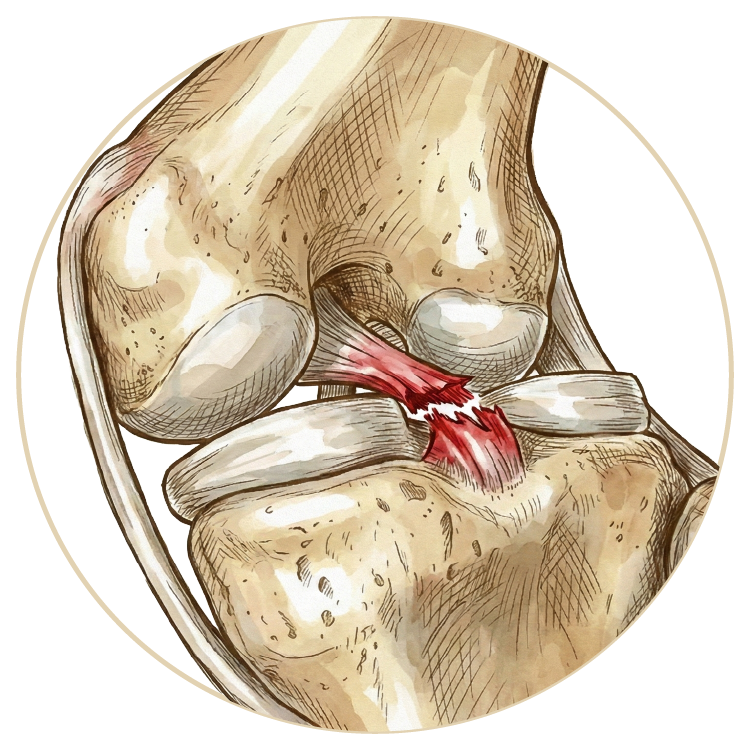
Knee ligament injury is a condition in which the anterior, posterior or lateral ligaments in the knee are partially or completely damaged.

Dr. Atakan Güvendiren
Orthopaedics and Traumatology · Istanbul
▶ Anterior Cruciate Ligament Rupture: Symptoms and Surgical Process
{ AI · initial information }
onlineLet's discuss your knee
AI answers do not replace a medical diagnosis.
Short videos on the topic
All videos →Brief explanations on this topic from the clinic's YouTube channel.

Anterior Cruciate Ligament Tear: Who Should Have Surgery?
Early diagnosis and appropriate treatment are critical for preserving knee function and preventing long-term joint damage.
Doesn't your knee feel secure when walking?
What is knee ligament injury?
Knee ligament injury is a condition in which the anterior, posterior or lateral ligaments in the knee are partially or completely damaged. Ligament injuries typically occur as a result of sports injuries, sudden twisting, falls or trauma. Early diagnosis and appropriate treatment are critical for preserving knee function and preventing long-term joint damage.
Grades of Knee Ligament Injury
Grade 1 Injury (Mild)
-
There are small tears or stretches in the ligament fibres.
-
It typically presents with mild pain, slight swelling and minimal instability.
Grade 2 Injury (Moderate)
-
There is a partial rupture of the ligament fibres.
-
Significant pain, swelling and restricted movement in the knee may develop.
-
The knee may sometimes feel loose.
Grade 3 Injury (Complete Rupture)
-
The ligament is completely ruptured.
-
Severe pain in the knee, a sudden 'pop' sensation and marked instability are observed.
-
Urgent assessment and often surgical intervention is required.
Confidence and balance in the knee through ligament treatment
Feelings of insecurity, pain and restricted movement in the knee joint resulting from ligament injuries can be managed with appropriate treatment approaches. In cases where conservative methods are ineffective and knee stability is inadequate, ligament repair or reconstructive surgical methods are applied as effective treatment options aimed at restoring knee function and enabling safe movement.
"With appropriate treatment of knee ligament injuries, safe and balanced movement can be restored."
Solutions preserving knee function in ligament damage
Knee ligament injuries can lead to feelings of insecurity, pain, restricted movement and loss of function resulting from disrupted stability in the knee joint. This can significantly reduce quality of life. Rest, medication and physiotherapy are initially preferred. When these methods do not provide adequate benefit, ligament repair or reconstructive surgical methods are applied as effective treatment options aimed at restoring knee stability, reducing pain and enabling safe movement. Dr. Atakan Güvendiren
What are knee ligaments and what do they do?
The knee joint is one of the body's most complex and mobile joints. Knee ligaments serve as critical structures that maintain the stability of the joint and enable bones to move in the correct position. When these ligaments are damaged, pain, instability and loss of function can occur in the knee.
Anatomy and function of knee ligaments
Anterior Cruciate Ligament (ACL – Anterior Cruciate Ligament)
-
Prevents forward sliding between the tibia and femur in the knee.
-
Plays an active role during sudden changes of direction or stopping.
-
One of the ligaments most frequently injured in athletes.
Posterior Cruciate Ligament (PCL – Posterior Cruciate Ligament)
-
Prevents the tibia from sliding backwards and provides posterior stability in the knee.
-
Usually injured in traffic accidents or high-energy trauma.
Medial Collateral Ligament (MCL – Medial Collateral Ligament)
-
Prevents the knee from opening in side impacts to the inner part of the knee.
-
Increases the knee's resistance to lateral forces.
Lateral Collateral Ligament (LCL – Lateral Collateral Ligament)
-
Provides stability to the lateral side of the knee.
-
Keeps the knee balanced during lateral impacts and sudden turns.
Why are knee ligaments important?
-
Provide stability: Enable the knee to move correctly during walking, running and jumping.
-
Maintain balance: Prevent the knee from twisting during sudden movements.
-
Long-term health: If ligament injuries are left untreated, meniscal and cartilage damage can develop, and the risk of osteoarthritis increases.
Anterior Cruciate Ligament (ACL) Injury Symptoms
Anterior Cruciate Ligament (ACL) injuries are commonly seen in athletes during sudden changes of direction, stopping or jumping movements.
Symptoms:
-
Sudden and severe pain in the knee
-
A 'pop' sensation or feeling of bursting at the moment of injury
-
Rapid swelling and oedema in the knee
-
Feeling of looseness or instability when standing tall or walking
-
Restricted movement and difficulty
-
In some cases, joint locking together with meniscal injury
Important points:
-
ACL injury can occur alone or together with other ligament injuries.
-
Diagnosis is made by physical examination and MRI imaging.
-
Early diagnosis and appropriate treatment are critical for preserving knee stability and preventing long-term complications.
Medial Collateral Ligament (MCL) Injury Symptoms
The medial collateral ligament (MCL) is an important ligament that provides medial stability of the knee and balances lateral forces. MCL injuries typically occur as a result of sports activities, such as football or skiing, where lateral impacts are common.
Symptoms:
-
Pain and tenderness on the inner side of the knee
-
Swelling and oedema following the injury
-
Mild to moderate restricted movement in the knee
-
Sometimes a feeling of looseness or instability in the knee
-
Weakness in the knee against lateral forces in severe injuries
Important points:
-
MCL injuries often heal with conservative methods in mild and moderate sprains.
-
Surgical intervention may be necessary for severe ruptures or multiple ligament injuries.
-
Early diagnosis and appropriate rehabilitation are critical for preserving knee stability and maintaining long-term joint health.
Lateral Collateral Ligament (LCL) Injury Symptoms
The lateral collateral ligament (LCL) is an important ligament that provides lateral stability of the knee and keeps the knee balanced against lateral impacts. LCL injuries typically occur as a result of sports activities, sudden changes of direction or lateral trauma.
Symptoms:
-
Pain and tenderness on the outer side of the knee
-
Swelling or oedema following the injury
-
Looseness and lateral instability of the knee
-
Difficulty with knee movements, particularly pain with lateral (side) pressure
-
In some cases, joint locking or catching sensation
Important points:
-
LCL injuries generally heal with conservative treatment in mild to moderate cases.
-
In cases of severe rupture or multiple ligament injuries, surgery may be necessary.
-
Early diagnosis and appropriate rehabilitation are critical to preserving knee stability and maintaining long-term joint health.
Posterior Cruciate Ligament (PCL) Injury Symptoms
The posterior cruciate ligament (PCL) is an important ligament that provides rear stability to the knee and prevents the tibia from slipping backwards. PCL injuries usually occur during traffic accidents, falls or sporting injuries, and often present with less obvious symptoms.
Symptoms:
-
Mild to moderate pain in the knee, particularly at the back
-
Looseness or instability in the knee, especially when going up hills or climbing stairs
-
A "pop" sound may sometimes be heard at the moment of injury
-
Mild swelling and joint tenderness
-
In some cases, bruising at the back of the knee or joint haemorrhage
-
PCL injury alone can sometimes be masked by mild symptoms, which is why careful assessment is required
Important points:
-
PCL injuries can usually be managed with conservative treatment, though severe ruptures may require surgery.
-
Early diagnosis is important for preserving knee stability and preventing meniscal or cartilage damage in the long term.
-
In athletes and active individuals, physiotherapy and rehabilitation play a critical role.
What Diagnostic Methods Are Used in Knee Ligament Injuries?
Correct diagnosis of knee ligament injuries is critical for determining the treatment plan and preventing complications. The diagnostic process uses both physical examination and imaging methods.
1. Physical Examination
-
Knee instability tests: Lachman test, anterior/posterior drawer test, valgus/varus stress test
-
Range of motion assessment: pain or locking during knee flexion and extension
-
Palpation: detection of swelling, tenderness and abnormalities in the joint space
2. X-ray Imaging
-
Assessment of bone structure and joint space
-
Although it does not usually provide direct diagnosis of ligament injuries, it is used to identify associated bone fractures or dislocations
3. Magnetic Resonance Imaging (MRI)
-
Shows ligament, meniscus and cartilage tissues in detail
-
Is the gold standard for determining the grade of ACL, PCL, MCL and LCL injuries
-
Provides critical information for surgical planning
4. Ultrasound (In Some Cases)
-
Can be used for dynamic assessment of soft tissues and ligaments
-
Is particularly helpful in MCL and LCL injuries
What Are the Non-Surgical Treatment Options for Knee Ligament Injuries?
Knee ligament injuries do not always require surgery. In mild to moderate injuries, non-surgical treatment methods are highly effective at preserving knee stability and accelerating healing.
1. Rest and Activity Modification
-
Rest is important to prevent overloading the knee after injury.
-
Activities that increase pain are temporarily limited or modified.
2. Ice Application and Swelling Control
-
Ice application within the first 48 hours reduces swelling and pain.
-
Application 3–4 times a day for 15–20 minutes is recommended.
3. Medication
-
Analgesics and anti-inflammatory medications can be used with doctor's advice.
-
Helps reduce swelling and inflammation.
4. Knee Bracing and Supportive Measures
-
Knee braces, bandages or elastic supports increase knee stability and prevent worsening of the injury.
-
Functional knee braces may be preferred in athletes or active individuals.
5. Physiotherapy and Exercises
-
Supports knee stability by building muscle strength.
-
Exercises strengthening the quadriceps and hamstring muscles prevent injury recurrence.
-
Restores balance, flexibility and range of motion.
6. Rehabilitation Process
- The treatment plan may last 3–12 weeks depending on the type and grade of injury.
What Surgical (Operative) Approaches Are Used in Knee Ligament Injuries?
Surgical intervention is necessary when non-operative methods are insufficient in knee ligament injuries or when there are serious tears. Surgical treatment restores knee stability and prevents long-term damage to the meniscus and cartilage.
ACL (Anterior Cruciate Ligament) Reconstruction
-
It is the most common surgical method in ACL injuries.
-
The injured ligament is removed or repaired, and a graft ligament (autograft or allograft) is placed in its place.
-
The aim is to restore anterior stability of the knee and enable return to sports activities.
PCL (Posterior Cruciate Ligament) Repair
-
Reconstruction or repair can be performed in PCL injuries.
-
It is typically preferred in high-energy trauma or multiple ligament injuries.
MCL and LCL Repairs
-
Mild injuries typically heal with non-operative treatment, but severe tears require surgical intervention.
-
Ligament repair or reconstruction restores lateral stability of the knee.
Surgical Treatment of Combined Multiple Ligament Injuries
-
When multiple ligaments are injured simultaneously, multiple ligament repairs are performed.
-
Surgery is critical to preserve knee function and stability.
Arthroscopic Surgery Advantages
-
It is a minimally invasive method, providing less pain and faster recovery.
-
It allows detailed evaluation of intra-articular structures.
-
Meniscal and cartilage damage can be treated simultaneously.
Post-Operative Rehabilitation
-
Surgical success is supported by rehabilitation.
-
Physiotherapy restores muscle strength, range of motion, and balance.
-
The timeframe for return to sports and daily activities after surgery varies depending on the injury and surgical technique.
What is the Recovery Process After Knee Ligament Surgery?
Proper rehabilitation and care after knee ligament surgery are critical for the knee to regain function and to reduce the risk of re-injury. The recovery process varies depending on the type of surgery, the severity of the injury, and the patient's overall health status.
First Days After Surgery
-
The knee is typically supported with a knee brace or elastic bandage.
-
Ice application and activity modification control swelling and pain.
-
Painkillers and anti-inflammatory medications can be used under medical supervision.
Weeks 2–6
-
Knee loading is gradually increased with gentle standing and short walks.
-
Physiotherapy exercises begin to maintain muscle strength and range of motion.
-
Use of crutches or walking stick may continue according to medical advice.
Weeks 6–3 months
-
Exercises to increase knee flexibility and stability are intensified.
-
Light resistance movements and balance work begin.
-
Gradual return to active daily living activities.
Months 3–6
-
Muscle strengthening and coordination exercises continue.
-
For athletes, return to low-impact sports activities can be planned during this period.
-
Full weight-bearing on the knee and normal walking function are achieved.
Months 6–12
-
Return to intense sports activities can take place during this period.
-
Full stability and functional recovery are the goal.
-
Regular follow-up and monitoring reduce the risk of long-term complications.
Frequently Asked Questions
undefined
undefined
undefined
undefined
undefined
undefined
undefined
undefined
undefined
undefined
undefined
undefined
undefined
undefined
undefined
undefined
undefined
undefined
undefined
undefined
undefined
undefined
undefined
undefined





Schedule an Appointment
Your information will be sent to Dr. Atakan Güvendiren's clinic. A response will be provided within 24 hours.