
Ankle replacement
Ankle prosthesis is the replacement of the ankle joint, which has lost its function due to advanced ankle joint arthritis, post-traumatic joint damage or rheumatic diseases, with an artificial joint. The main purpose of this treatment is to reduce pain, preserve joint movement and improve the patient's daily

Dr. Atakan Güvendiren
Orthopaedics and Traumatology · Istanbul
{ AI · initial information }
onlineLet's discuss prosthesis surgery
AI answers do not replace a medical diagnosis.
Ankle prosthesis is the replacement of the ankle joint, which has lost its function due to advanced ankle joint arthritis, post-traumatic joint damage or rheumatic diseases, with an artificial joint.
Ankle Problems
Slowing Down Your Pace of Life?
Ankle prosthesis is the replacement of the ankle joint, which has lost its function due to advanced ankle joint arthritis, post-traumatic joint damage or rheumatic diseases, with an artificial joint. The main purpose of this treatment is to reduce pain, preserve joint movement and improve the patient's quality of daily life.
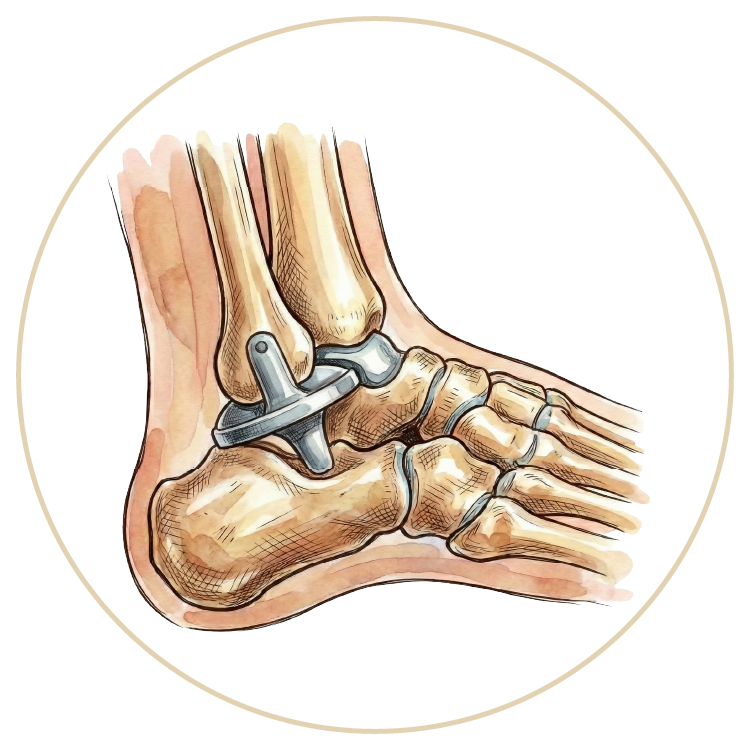
Ankle prosthesis is applied by replacing the bone surfaces that make up the ankle joint with specially designed metal and polyethylene prosthetic components. Modern ankle prostheses used today aim to provide function closest to the joint's natural movement.
Comfortable Movement with Ankle Prosthesis
Advanced damage developing in the ankle joint can be managed with appropriate treatment approaches. In cases where conservative methods do not provide benefit, ankle prosthesis is an effective surgical treatment option aimed at reducing pain and improving walking comfort.
With appropriate treatment for ankle joint problems, comfortable steps can be regained.
Effective Solution for Ankle Problems: Ankle Prosthesis
Ankle prosthesis is a surgical treatment method applied in patients with advanced cartilage loss and joint damage in the ankle joint. This condition can lead to pain, walking difficulties, limited movement and a significant decrease in quality of life. Medication treatments, physiotherapy and injections are preferred at the first stage. When sufficient benefit cannot be obtained from these methods, ankle prosthesis surgery is applied as an effective treatment option aimed at reducing pain, improving joint function and restoring comfortable walking. Dr. Atakan Güvendiren
Who is Ankle Prosthesis Suitable For?
Ankle prosthesis is an appropriate surgical option for patients with advanced ankle joint damage who have not benefited from other treatment methods. The main purpose of this operation is to reduce pain, preserve joint movement and enable the patient to continue daily life activities more comfortably.
The suitability of ankle prosthesis is evaluated considering many factors such as the patient's age, degree of joint damage, bone structure and lifestyle.
Patients with Advanced Ankle Joint Arthritis
Ankle arthritis (osteoarthritis) develops as a result of severe joint cartilage wear. In advanced stages, patients experience increasing pain during walking, morning stiffness and limited movement. Patients whose complaints persist despite medication treatment, physiotherapy and injections are suitable candidates for ankle prosthesis.
Patients with Post-Traumatic Ankle Damage
Previous fractures, ligament injuries or severe ankle trauma can damage the joint surface. If pain and loss of function resulting from post-traumatic injury have become permanent, ankle prosthesis may be an effective treatment option.
Patients with Rheumatoid Arthritis and Inflammatory Rheumatic Diseases
Inflammatory rheumatic diseases such as rheumatoid arthritis can cause progressive damage to the ankle joint. In this patient group, ankle prosthesis provides significant advantages in terms of reducing pain and preserving joint function.
Patients Severely Affected in Their Daily Life
For patients unable to walk due to pain, unable to stand for long periods, struggling to climb stairs, and experiencing a marked reduction in quality of life, an ankle prosthesis can be an appropriate solution.
Patients Wishing to Preserve Joint Motion
Ankle arthrodesis (joint fusion) completely eliminates joint motion. In suitable patients who do not wish to lose joint movement and want to maintain an active lifestyle, an ankle prosthesis is considered the preferred option.
Suitable Patient Profile for Ankle Prosthesis
In general, an ankle prosthesis is more suitable for patients with the following characteristics:
-
Middle-aged and older
-
Not overweight
-
Not engaged in heavy work
-
With adequate muscular and ligamentous structures around the ankle
Able to comply with post-operative rehabilitation
Is an Ankle Prosthesis Suitable for Everyone?
An ankle prosthesis is not suitable for every patient. It may not be recommended in patients with active infection, severe bone loss, serious vascular or nerve problems, or uncontrolled diabetes. For this reason, the decision must always be made by an orthopaedic and trauma specialist.
Ankle Osteoarthritis and the Path to Prosthesis
Ankle osteoarthritis is a progressive condition that develops as the cartilage covering the ankle joint surfaces wears away over time and the joint structure deteriorates. In this process, joint movements become painful, walking function declines, and the patient's quality of life is seriously reduced.
Although ankle osteoarthritis is rarer than knee and hip osteoarthritis, it often develops following trauma, and can occur even at younger ages.
What Causes Ankle Osteoarthritis?
The most common causes of ankle osteoarthritis are:
-
Ankle fractures and ligament injuries
-
Joint surface damage following trauma
-
Inflammatory rheumatic diseases such as rheumatoid arthritis
-
Prolonged loading on the joint and uneven weight-bearing
-
Congenital or acquired ankle deformities
These factors cause the joint cartilage to gradually thin over time and the bones to rub against each other.
Symptoms of Ankle Osteoarthritis
As osteoarthritis progresses, patients experience the following complaints:
-
Increasing ankle pain during walking
-
Stiffness in the morning or after prolonged immobility
-
Swelling and stiffness in the ankle
-
Reduced range of motion
-
Unable to stand for long periods and limping
At an advanced stage, pain may persist even at rest.
Initial Treatment Options for Ankle Osteoarthritis
In the early and intermediate stages of osteoarthritis, non-surgical treatments are applied first:
-
Pain-relieving and anti-inflammatory medications
-
Physiotherapy and exercise programmes
-
Orthopaedic insoles and shoe modifications
-
Intra-articular injections (corticosteroid, PRP, hyaluronic acid)
These methods aim to relieve symptoms but do not reverse cartilage loss.
When Does Prosthesis Come Into Consideration?
Ankle prosthesis treatment comes into consideration in the following situations:
-
Pain persisting despite non-surgical treatment
-
Significant limitation of daily living activities
-
Serious reduction in walking distance
-
Advanced joint surface damage
-
Search for an alternative to ankle arthrodesis
At this stage, an ankle prosthesis offers a solution that both reduces pain and preserves joint movement.
How Is the Path to Prosthesis Planned?
Before a prosthesis decision is made, a detailed evaluation is performed. The joint structure is analysed using physical examination, X-ray, MRI and, if necessary, CT imaging. Considering the patient's age, bone quality, weight status and lifestyle, the most appropriate treatment plan is created.
The goal is to intervene at the right time and with the most appropriate method.
How Does an Ankle Prosthesis Work?
An ankle prosthesis is an artificial joint system designed to mimic the natural movement of the damaged ankle joint. The aim is to eliminate painful and non-functional joint surfaces to provide a mobile, balanced and pain-free ankle.
Modern ankle prostheses are made up of specially designed components that preserve the joint's biomechanics and distribute the load placed on the foot during walking in a balanced manner.
Basic Components of an Ankle Prosthesis
An ankle prosthesis generally consists of three main parts:
-
Tibial component: the metal surface placed on the tibia (shin bone)
-
Talar component: the metal part placed on the talus bone, which forms the lower part of the ankle joint
-
Polyethylene spacer: a specially designed plastic layer positioned between these two metal surfaces that reduces friction and enables movement
Thanks to this structure, the prosthesis provides a function close to the ankle's natural joint movements.
How Does an Ankle Prosthesis Enable Movement?
An ankle prosthesis allows the foot to make controlled up and down movements (dorsiflexion and plantarflexion). During walking, the load created is transferred to the bones in a balanced manner through the prosthetic components.
Modern prostheses with a mobile design reduce stress on the joint, increasing walking comfort and contributing to the protection of neighbouring joints (knee and hip).
Difference Between Fixed and Mobile Ankle Prostheses
Ankle prostheses may differ according to their design:
-
Fixed-bearing prostheses provide more limited movement and are preferred in certain patient groups.
-
Mobile-bearing prostheses provide a structure closer to natural joint movement and are more commonly used today.
Which prosthesis is preferred is determined based on the patient's joint structure and bone quality.
How Does an Ankle Prosthesis Affect Walking?
Thanks to an ankle prosthesis, patients:
-
Can walk with better balance
-
May experience reduced limping
-
Feel less pain during longer walking distances
This results in a marked increase in comfort during daily living activities.
Does an Ankle Prosthesis Work Like a Natural Joint?
No prosthesis is exactly the same as a natural joint. However, modern ankle prostheses used today provide movement capability very close to a natural joint. With correct patient selection and successful surgery, problem-free use for many years is possible.
What Are the Advantages of an Ankle Prosthesis?
An ankle prosthesis is a modern surgical method applied to reduce pain and preserve movement capability in patients with advanced ankle osteoarthritis and joint damage. When applied with correct patient selection and appropriate surgical technique, an ankle prosthesis offers many important advantages.
Marked Reduction in Pain
One of the most important advantages of ankle replacement is the significant reduction in chronic pain that restricts daily life. As the damaged joint surfaces are removed, patients experience a more comfortable life in the post-operative period.
Preservation of Joint Movement
Unlike ankle arthrodesis (joint fusion), ankle replacement preserves joint movement. This allows patients to develop a more natural walking pattern and minimises joint stiffness.
More Natural Walking and Balance
Ankle replacement enables balanced weight distribution on the foot during walking. This helps reduce limping, increases walking distance, and improves overall balance control.
Protection of Adjacent Joints
When the ankle joint is fused, the load on the knee and hip joints increases. Ankle replacement, by preserving joint movement, helps keep the knee, hip and foot joints healthier for longer.
Increased Quality of Daily Life
After ankle replacement, patients can climb stairs, stand for long periods and perform daily activities more comfortably. This provides a marked improvement in overall quality of life.
Easier Return to Active Life
In suitable patients, ankle replacement offers the opportunity for a quicker return to social activities and low-impact activities. Walking, light exercise and daily activities can generally be performed safely.
Long-Lasting and Durable Solution
Modern ankle replacements used today can demonstrate durability over many years thanks to advanced materials and design. With proper use and regular check-ups, the prosthesis lifespan can be further extended.
Providing an Alternative to Arthrodesis
Ankle replacement provides an effective alternative to arthrodesis for patients who do not wish to lose joint movement. It offers a significant advantage, particularly for patients with expectations for an active lifestyle.
How is the Recovery Process After Ankle Replacement?
The recovery period after ankle replacement surgery can vary depending on the patient's general health status, bone structure, the type of prosthesis used and compliance with rehabilitation. However, with proper planning and regular follow-up, the vast majority of patients can return to their daily lives in a pain-free and more mobile way.
Immediate Post-Operative Period (0–2 Weeks)
After surgery, the ankle is typically immobilised with a splint or cast. During this period:
-
Weight-bearing is not permitted
-
Elevation of the foot is recommended to reduce swelling and pain
-
Medication is given to prevent infection and blood clots
Early Rehabilitation Period (2–6 Weeks)
During this period:
-
The cast or splint may be removed
-
Partial weight-bearing can begin (under medical supervision)
-
Light movement exercises help prevent joint stiffness
Physiotherapy is very important during this period.
Functional Recovery Period (6–12 Weeks)
-
Full weight-bearing walking typically begins during this period
-
Ankle mobility and muscle strength are increased
-
Daily activities can be performed more comfortably
Long-Term Recovery (3–6 Months)
-
Pain decreases markedly
-
Walking quality improves
-
Patients mostly return to their daily lives
Medical approval is required before sports and high-impact activities.
Factors Affecting the Recovery Process
-
Patient's age and weight status
-
Additional conditions such as diabetes and smoking
-
Regular participation in physiotherapy
-
Compliance with medical advice
Frequently Asked Questions
undefined
undefined
undefined
undefined
undefined
undefined
undefined
undefined
undefined
undefined
undefined
undefined
undefined
undefined
undefined
undefined
undefined
undefined
undefined
undefined





Schedule an Appointment
Your information will be sent to Dr. Atakan Güvendiren's clinic. A response will be provided within 24 hours.